

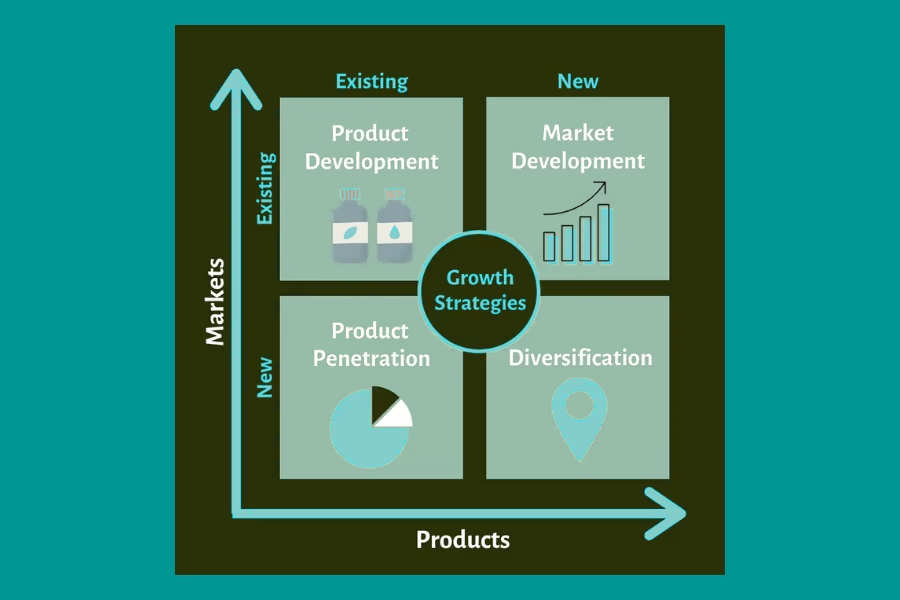
For many small businesses, tenders have historically felt like something that happens in another world. Complicated portals, unfamiliar language, long documents, and the assumption that public sector contracts are only for large organisations have kept many SMEs on the sidelines.
That is changing fast.
In 2026, more small businesses than ever are winning work through tenders. Not because the process has become easier, but because the environment has shifted and those who understand how to approach tenders strategically are gaining a real advantage.
This is not about bidding for everything. It is about being selective, prepared, and supported. For small businesses willing to engage properly, tenders are no longer a last resort. They are a viable and often reliable growth strategy.
The 2026 Procurement Landscape Is Favourable to Small Businesses
Public sector spending remains one of the most stable sources of work in the UK economy. While private sector demand can fluctuate sharply, government bodies, local authorities, NHS trusts, housing associations, and education providers still need services delivered.
In recent years, procurement policy has actively shifted to encourage greater SME participation. Contract values are increasingly broken into lots, Dynamic Purchasing Systems are more common, and frameworks are being designed to reduce unnecessary barriers to entry.
Organisations such as Crown Commercial Service have been tasked with improving supplier diversity and opening up opportunities to smaller providers. This is not theoretical. It is showing up in real contract awards.
Small businesses that understand where opportunities sit and how to position themselves are already benefiting.
Tenders Are No Longer Just for Large Companies
One of the biggest misconceptions around tenders is that they favour scale over substance. In reality, many contracting authorities actively look for specialist expertise, flexibility, and local knowledge.
Small businesses often outperform larger competitors in areas such as responsiveness, innovation, social value delivery, and customer experience. These factors now carry significant weight in evaluations.
Procurement teams are not simply buying the cheapest option. They are buying confidence in delivery, risk management, and outcomes. Small businesses that can articulate these clearly often score very well.
The key difference is not size. It is preparedness.
Why Small Businesses Have Historically Struggled With Tenders
If tenders are becoming more accessible, why do so many small businesses still struggle to win?
The reasons are consistent:
- Poor understanding of what evaluators are actually scoring
- Responses that describe services but fail to evidence outcomes
- Lack of structure and clarity in written submissions
- Underestimating the time and planning required
- Chasing unsuitable opportunities without a clear bid strategy
Price is rarely the main reason bids fail. More often, it is unclear messaging, weak evidence, or a failure to directly answer the question being asked.
These issues are not a reflection of capability. They are a reflection of experience.
The Shift From Opportunistic Bidding to Strategic Growth
In 2026, the small businesses winning tenders are not bidding reactively. They are treating tenders as part of a wider growth plan.
This means:
- Understanding which types of contracts align with their delivery model
- Knowing when to lead, when to subcontract, and when to walk away
- Investing in core content that can be reused and refined
- Building a track record intentionally rather than accidentally
This approach reduces wasted effort and increases win rates. It also makes tendering far less disruptive to day-to-day operations.
For many businesses, this shift starts with external support.
For wider business growth planning visit.
Why Supported Bidding Delivers Better Outcomes
Very few small businesses can justify a full-time bid team. The workload is inconsistent, the skill set is specialist, and the cost rarely stacks up.
As a result, many SMEs now outsource part or all of their tender activity. This can include opportunity review, bid writing, compliance checks, or full end-to-end submission.
The benefit is not just better writing. It is better decision making with professional tender support.
Supported bidding helps businesses:
- Avoid unsuitable opportunities early
- Structure responses in line with evaluation criteria
- Present evidence clearly and consistently
- Reduce internal time pressure
- Learn from each submission
This model mirrors how many small businesses already operate in other areas, such as finance, HR, and legal support.
It is also where alignment with wider business strategy becomes critical.
Aligning Tenders With Broader Business Growth
Tenders should never sit in isolation. They affect cash flow, resourcing, delivery capacity, and risk.
This is why many businesses approach tenders as part of a wider growth conversation supported by partners such as Aspire to Grow. When bidding decisions are informed by financial planning, operational readiness, and long-term goals, the results are stronger and more sustainable.
Winning a contract that stretches a business beyond its limits can be as damaging as not winning at all. Strategic alignment matters.
Lead, Subcontract, or Partner: Choosing the Right Route
Another major shift in 2026 is the rise of flexible delivery models.
Small businesses are increasingly:
- Leading bids with specialist delivery partners
- Subcontracting to gain experience and evidence
- Forming consortia for larger contracts
- Joining frameworks to build pipelines rather than chase one-off wins
Each route has advantages. The right choice depends on capacity, appetite for risk, and long-term ambition.
Understanding these options and using them deliberately allows small businesses to grow into tendering rather than being overwhelmed by it.
Where to Find Opportunities and Trusted Guidance
A common fear is simply knowing where to look. Fortunately, there are well-established, transparent systems in place.
Key platforms and guidance include:
- GOV.UK resources explaining public procurement and supplier obligations
- The Find a Tender service for regulated contracts
- Contracts Finder for lower-value public sector opportunities
- Guidance from the Crown Commercial Service on frameworks and supplier readiness
Using official sources not only helps identify opportunities but also builds understanding of expectations and compliance.
Why 2026 Is the Right Time to Start or Reset
For small businesses that have avoided tenders in the past, 2026 represents a genuine opportunity to reset.
The environment is more SME-friendly than it has ever been. Digital portals are more consistent. Evaluation criteria are clearer. Social value and quality now sit alongside price.
Most importantly, the businesses succeeding are not the biggest. They are the best prepared.
With the right strategy, realistic opportunity selection, and appropriate support, tenders can move from being intimidating to being transformative.
Final Thought: Tenders as a Growth Lever, Not a Gamble
Tenders should never feel like a gamble. When approached properly, they are a structured, repeatable way to secure work, build credibility, and stabilise income.
Small businesses that treat tendering as part of their growth plan, rather than a desperate attempt to win work, are the ones setting themselves up for long-term success.
If 2026 is the year you want more control over your pipeline, tenders deserve serious consideration.