

Many suppliers spend hours preparing a tender response, only to discover they have scored lower than expected.
The frustration is understandable. Businesses know they can deliver the work, have relevant experience, and often offer competitive pricing. Yet when the evaluation results arrive, they find themselves behind competitors that appear less experienced or less established.
The reality is that procurement evaluators are not assessing who you are. They are assessing what you have written.
A successful tender response is not simply a description of your business. It is a structured document designed to give buyers confidence that you can deliver the contract successfully whilst minimising risk.
Understanding what buyers really want to see in a tender response can significantly improve your chances of winning public sector contracts.
As more organisations enter the public procurement market, understanding what buyers expect from a tender response is becoming increasingly important. This builds on our earlier article Why More Small Businesses Will Win Work Through Tenders in 2026.
How Procurement Evaluators Review a Tender Response
One of the biggest misconceptions in procurement is that evaluators read every tender response from start to finish like a report.
In reality, evaluators are working through multiple submissions against predefined scoring criteria and often under strict timescales.
Their role is to identify evidence that justifies awarding marks.
Guidance published by the Crown Commercial Service highlights the importance of objective evaluation against predefined scoring criteria.
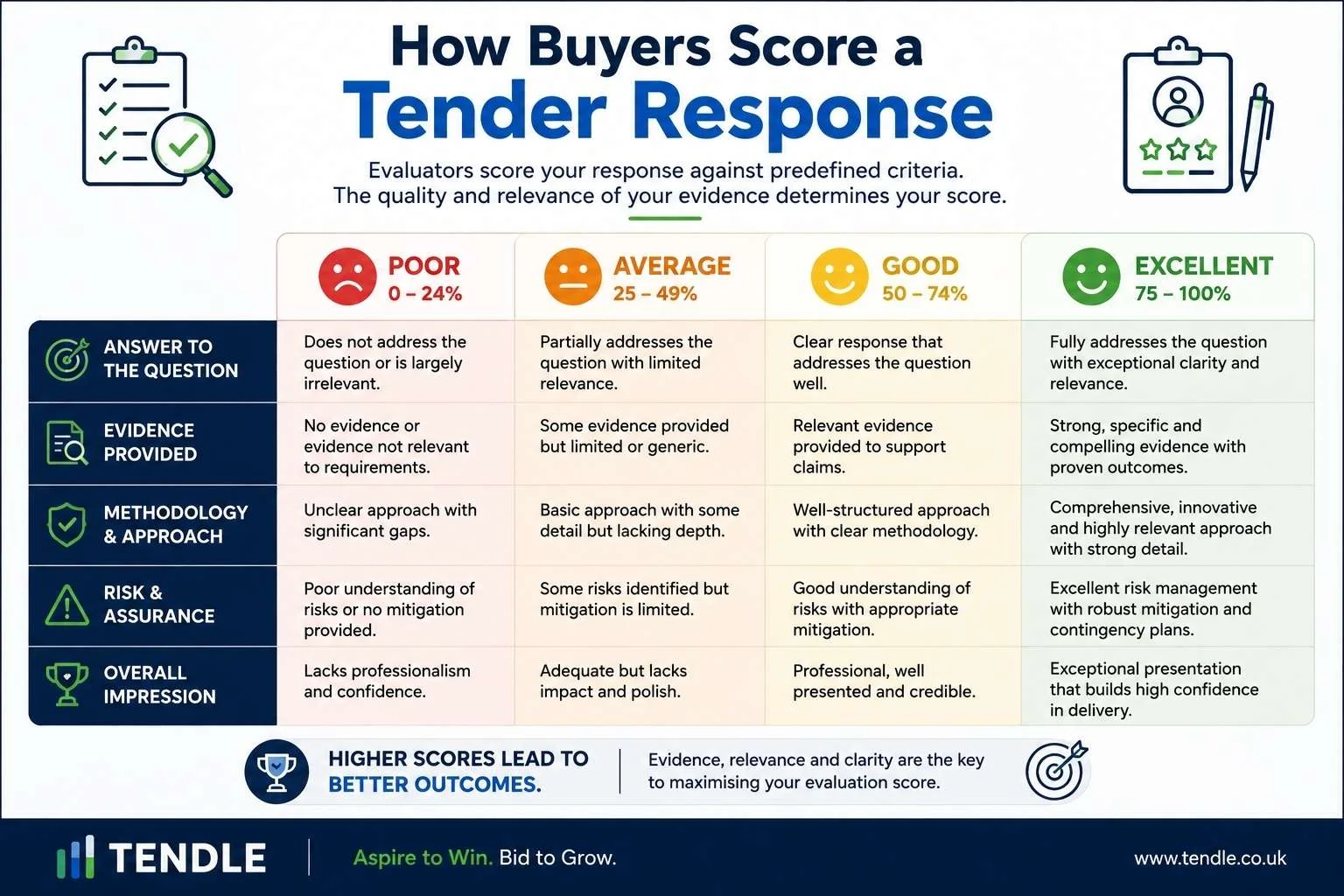
This means your tender response needs to be:
- Clear
- Structured
- Relevant
- Evidence based
- Easy to score
If evaluators have to search for information, your score will often suffer.
This is why presentation and structure are just as important as the quality of your content.
Buyers Want Evidence, Not Promises
A common weakness in many submissions is relying on generic statements.
Examples include:
- We are committed to quality
- We always put customers first
- We provide an excellent service
Whilst these statements may be true, they are extremely difficult for evaluators to score.
What Buyers Actually Want to See
A stronger tender response includes:
- Relevant case studies
- Measurable outcomes
- Client testimonials
- Performance data
- Lessons learned
Evidence transforms claims into credibility.
Building and maintaining an evidence library is one of the key areas assessed when reviewing a business’s tender readiness.
The best tender response provides proof rather than promises.
Buyers Want Confidence in Delivery
Procurement teams are responsible for reducing risk.
When evaluating a tender response, buyers are often asking themselves:
- Can this supplier deliver?
- Can they manage challenges?
- Do they understand the requirements?
- Can they meet deadlines?
- Do they have sufficient resources?
What a Strong Methodology Should Include
Your methodology section should explain:
- How the contract will be delivered
- Key milestones
- Resource allocation
- Quality management
- Communication arrangements
- Performance monitoring
The more confidence you provide, the easier it becomes for evaluators to award marks.
Relevant Experience Matters More Than Volume
Many businesses assume they need extensive experience to win contracts.
What buyers really want is evidence of relevant experience.
How to Demonstrate Relevant Experience
Your tender response should demonstrate:
- Similar projects
- Comparable challenges
- Relevant sectors
- Similar contract values
- Successful outcomes
Even if your experience is not identical, explain how it transfers to the opportunity.
A focused and relevant example often scores better than a long list of unrelated projects.
Risk Management Is a Major Scoring Area
Every contract involves risk.
Strong suppliers acknowledge this.
Weak suppliers avoid discussing it.
Demonstrating Risk Management in a Tender Response
A high-scoring tender response demonstrates:
- Awareness of potential risks
- Risk mitigation measures
- Escalation procedures
- Contingency planning
- Business continuity arrangements
Buyers understand risks exist.
What they want to know is how you will manage them.
Social Value Must Be Genuine
Social value continues to play an increasingly important role within public procurement.
This continues to be reinforced through GOV.UK Procurement Policy Notes, which place increasing emphasis on social value outcomes within procurement decisions.
However, many suppliers still treat it as an afterthought.
Examples of Strong Social Value Commitments
A strong tender response includes meaningful commitments such as:
- Local employment opportunities
- Apprenticeships
- Community engagement
- Environmental improvements
- Volunteering initiatives
- Supply chain development
Buyers are increasingly looking beyond promises and seeking evidence that commitments can be delivered.
Capacity and Resources Build Buyer Confidence
One of the biggest concerns for buyers is whether a supplier has sufficient resources to deliver the contract successfully.
Information Buyers Expect to See in a Tender Response
Your tender response should clearly explain:
- Staffing levels
- Key personnel
- Equipment availability
- Geographic coverage
- Supply chain arrangements
- Mobilisation plans
Capacity concerns often become a deciding factor when comparing closely matched suppliers.
Make Your Tender Response Easy to Score
Many suppliers accidentally make the evaluator’s job harder.
This happens when responses are:
- Overly complicated
- Poorly structured
- Repetitive
- Difficult to navigate
Simple Ways to Improve Readability
A successful tender response should include:
- Clear headings
- Logical sections
- Bullet points where appropriate
- Direct answers to questions
- Evidence aligned to scoring criteria
Remember, evaluators can only score what they can find.
Make it easy for them.
Common Tender Response Mistakes That Cost Marks
Across all sectors, similar mistakes appear repeatedly.
The Most Common Issues
- Not answering the question directly
- Failing to provide evidence
- Ignoring scoring criteria
- Using excessive marketing language
- Submitting generic responses
- Providing outdated case studies
- Weak social value commitments
Many of these issues can be avoided through stronger preparation and better tender readiness.
Many of these mistakes contribute directly to poor evaluation scores. If you’re interested in understanding the wider reasons bids fail, read The Real Reason Small Businesses Lose Tenders (And It’s Not Price).
The Link Between Tender Readiness and Tender Response Quality
The quality of a tender response is often determined long before the opportunity is released.
Businesses with:
- Up-to-date policies
- Strong case studies
- Evidence libraries
- Training records
- Social value data
- Organised documentation
are able to produce stronger submissions more efficiently.
Before businesses can produce a high-scoring tender response, they need the right foundations in place. Our recent article, Are You Tender Ready? 10 Warning Signs Your Business Isn’t Ready to Bid Yet, explores the documentation, processes, and evidence buyers often expect to see before evaluating a submission.
This is why many organisations focus on improving tender readiness before pursuing larger public sector opportunities.
Many businesses discover that improving tender response quality also highlights wider operational, commercial, and growth challenges. This is why organisations often seek support from Aspire to Grow Ltd alongside their procurement activities.
A strong foundation allows businesses to create a better tender response and improve their chances of success.
Businesses that struggle with evidence, structure, or scoring often benefit from independent review before submission. Tendle’s tender support services help organisations strengthen tender responses, improve quality scores, increase win rates, and build the procurement foundations needed for long-term success.
Final Thoughts
Many larger public sector opportunities are advertised through the Find a Tender Service, where buyers clearly outline evaluation criteria and quality requirements.
Smaller public sector opportunities can often be found through Contracts Finder, providing an accessible route into procurement for small businesses beginning their tendering journey.
A successful tender response is not about producing the longest document or making the biggest promises.
It is about making buyers feel confident.
Evaluators want evidence.
They want clarity.
They want reassurance that you understand the contract, can manage risks, and have the capability to deliver successfully.
The suppliers that consistently win contracts are rarely the ones making the boldest claims.
They are the ones making it easiest for buyers to award marks through a clear, evidence-based tender response.