

Table of Contents
- Introduction
- What Bids and Tenders Actually Look Like in Practice
- Where Small Businesses Lose Time and Opportunities
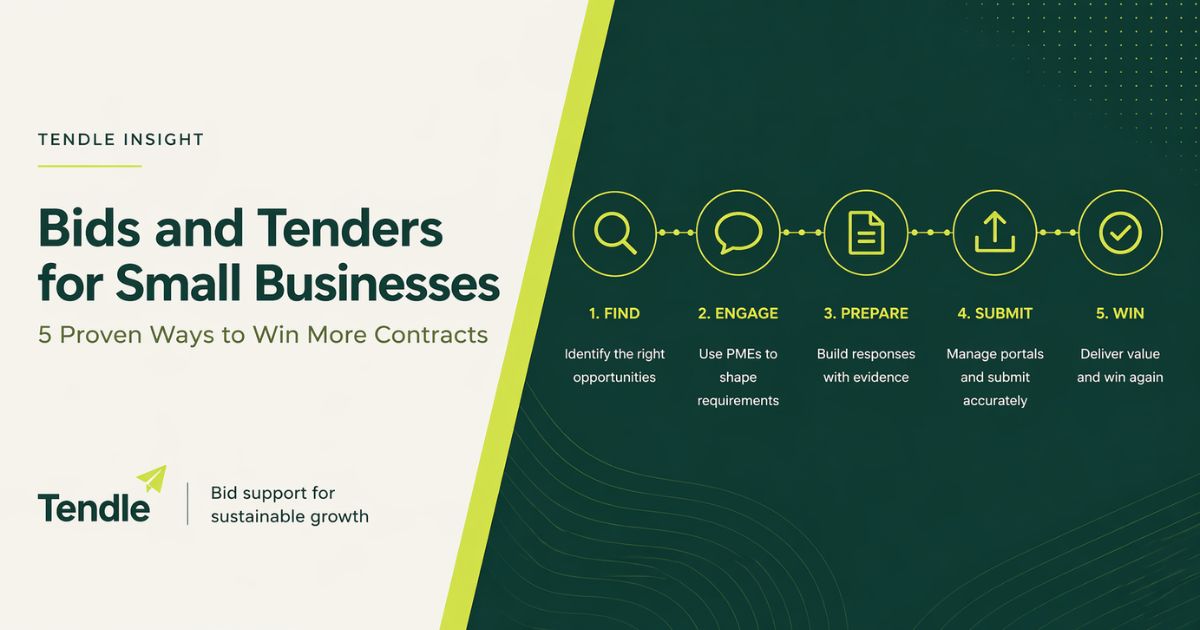
- 5 Proven Ways to Win More Contracts
- Building a Sustainable Bidding Function
- How Tendle Supports Small Businesses
- Final Thoughts
Introduction
Bids and tenders for small businesses are often positioned as a route to stable, long-term growth.
And in many cases, they are.
However, after a month working across live tenders, pre-market engagement responses, frameworks, and bid library development, a different picture starts to emerge.
Most small businesses are not losing bids because they lack technical capability.
They are losing because bidding is being treated as a one-off task, rather than a structured function within the business.
If you are currently exploring bid support for small businesses, taking a more structured approach is often the turning point between inconsistent results and a reliable pipeline of work.
What Bids and Tenders Actually Look Like in Practice
On paper, bids and tenders for small businesses appear straightforward.
A contract is published, a response is written, and a supplier is selected.
In practice, the process is far more layered.
A typical month of bidding activity includes:
- Reviewing pipeline notices and upcoming opportunities
- Completing pre-market engagement (PME) responses
- Assessing frameworks and Dynamic Purchasing Systems
- Managing multiple procurement portals
- Building and refining bid content and supporting documentation
Opportunities are often accessed through platforms such as ProContract, In-Tend, and Delta eSourcing.
You can also explore national opportunities through official sources like GOV.UK and frameworks managed by Crown Commercial Service.
The submission itself is only one part of a much wider system.
Where Small Businesses Lose Time and Opportunities
Late Engagement
Many businesses only review bids and tenders once they are live.
At that point:
- Specifications are fixed
- Competitors are already positioned
- There is little opportunity to influence requirements
Fragmented Processes
Managing multiple portals, documents, and deadlines without a clear structure leads to inefficiency.
Time is lost on:
- Re-entering the same information
- Uploading documents repeatedly
- Navigating different systems
Rewriting Instead of Reusing
Without a structured tender strategy, businesses recreate core responses for every submission.
This slows down delivery and introduces inconsistency.
Over-Bidding
Submitting for too many opportunities without proper qualification reduces overall success rates.
Effort is spread too thin, and quality suffers.
Misunderstanding Long-Term Positioning
Frameworks and Dynamic Purchasing Systems are often overlooked because they do not guarantee immediate work.
However, they are often the gateway to repeat opportunities.
5 Proven Ways to Improve Bids and Tenders for Small Businesses
1. Build a Bid Library That Reflects Your Business
A strong bid library is the foundation of consistent bidding.
This should include:
- Case studies with measurable outcomes
- Method statements
- Policies and compliance documents
- Team CVs
This approach is a core part of effective bids and tenders support and helps reduce time across future submissions.
2. Engage Before Opportunities Go Live
Pre-market engagement allows you to:
- Influence specifications
- Demonstrate expertise
- Position your business early
3. Qualify Opportunities Properly
Not every tender is worth pursuing.
Focus on:
- Strategic fit
- Commercial viability
- Resource availability
4. Use Frameworks and DPS as Growth Tools
Frameworks and DPS agreements provide:
- Access to future tenders
- Reduced competition pools
- Opportunities for repeat work
5. Build a Repeatable Bidding Process
Winning consistently requires structure.
This includes:
- Defined workflows
- Clear ownership
- Reusable content
- Ongoing pipeline tracking
Building a Sustainable Bidding Function
The most successful small businesses treat bidding as a structured part of their growth strategy.
This means:
- Planning ahead
- Investing in reusable content
- Tracking opportunities proactively
If you are looking to improve your approach, working with a specialist in bid support for small businesses can accelerate this process significantly.
How Tendle Supports Small Businesses
At Tendle, we help small businesses build a structured, commercially focused approach to bidding.
This includes:
- Opportunity identification and qualification
- Bid library development
- Portal and submission management
- Pre-market engagement support
- Full tender response delivery
You can learn more about our approach to bids and tenders support on our website:
Final Thoughts
Bids and tenders for small businesses are not just about writing strong responses.
They require:
- Structure
- Planning
- Consistency
Businesses that invest in these areas are far more likely to win work and build a sustainable pipeline.
Frequently Asked Questions About Bids and Tenders for Small Businesses
What are bids and tenders for small businesses?
Bids and tenders for small businesses are formal processes used by public sector organisations to select suppliers for contracts. Businesses submit structured responses outlining how they will deliver the required service, often through procurement portals and frameworks.
How can small businesses win more tenders?
Small businesses can improve their chances by building a strong bid library, engaging early through pre-market engagement, focusing on the right opportunities, and developing a consistent bidding process rather than treating each submission as a one-off task.
Are bids and tenders worth it for small businesses?
Bids and tenders can be highly valuable for small businesses when approached strategically. While they require time and structure, they offer access to stable, long-term contracts and repeat work opportunities, particularly through frameworks and DPS agreements.
What is a bid library and why is it important?
A bid library is a collection of reusable content such as case studies, policies, and method statements. It allows businesses to respond more efficiently to tenders, maintain consistency, and improve the quality of submissions over time.
What is pre-market engagement in tenders?
Pre-market engagement (PME) is an early stage in the procurement process where buyers gather feedback from suppliers before releasing a tender. It allows businesses to influence requirements and position themselves before the opportunity goes live.